
Axaeon
A new creative and philosophical endeavor


Entering the world of VTubers
I'm writing to announce an endeavor I've recently embarked on: being an educational VTuber—more precisely, a philosopher VTuber.
To some readers, the previous sentence will immediately raise the question of what in the world a VTuber is. Here, then, is a quick rundown: VTubers (short for "virtual YouTubers") are video content creators and/or streamers who use an animated avatar. VTubing started in Japan around the mid-2010s and picked up popularity worldwide during the pandemic. Since then, the medium has become one of the major categories of video content creation (e.g., in 2025 so far, most of the top 10 most-watched female streamers are VTubers), and certain well-publicized events and news articles have brought VTubing yet further into the mainstream (e.g., Hololive Night at Dodgers Stadium, along with articles in The Economist, Wired, and other publications). Some of the most popular VTubers currently are Houshou Marine, Ironmouse, and Usada Pekora. As these and other examples reflect, most VTubers' aesthetic is (naturally, given VTubing's Japanese origins) inspired by anime. Likewise having a heavy influence on VTubing is Japanese idol culture, as virtual talent and idol agencies, such as Hololive Production and Nijisanji, are behind many of the biggest VTubers, and singing and dancing remain among many VTubers' primary activities. Other common VTuber activities include gaming, drawing, and doing just-chatting streams.
I suppose you could say that I've had a bit of an unusual entry into VTubing. For most of the past few years, in the wake of getting my Ph.D., I've taught philosophy and writing at both the high school and college level. During all this time, though, I've also been following the world of VTubers. (My first exposure to VTubers happened during the pandemic: this stream by Inugami Korone, according to my YouTube watch history.) From the beginning, I was struck by the creative possibilities that VTubing offered. But it was only relatively recently that I worked up the will to set out as a VTuber (and, more broadly, philosophy content creator) myself.
My motivations for becoming a philosophy VTuber are multiple. On one level, I simply like the way in which VTubing allows so much room for creative storytelling, for kayfabe, for fashioning and acting out a character whose lore aligns, in some larger-than-life way, with the kinds of activities and content in one's streams. But also, yet more importantly to me, I think that VTubing can offer one way of helping people—perhaps especially (though certainly not strictly) young people, those who might be more familiar with or feel a greater draw to the aesthetics of the medium—to connect with philosophy in a way that reaches beyond the classroom. Many people have at least some interest in philosophy—its central questions, after all, such as what we can know or how we should live, are arguably relevant to everyone—but find it distant and mysterious or feel intimidated by it, as, in all too many cases, they might never have had a chance to learn about it in school. Those who face this circumstance will often, when seeking to learn about philosophy, turn to content creators they're already familiar with, especially when those content creators charismatically present themselves as infallible gurus (regardless of whether they in fact have any philosophical training to speak of). And, to a seeker of philosophical knowledge who has not yet had much exposure to philosophy, telling the difference between serious philosophy and pseudointellectual claptrap can be tremendously difficult. What I'd like to do as a philosopher VTuber, then, is to help people develop their capacity as critical, philosophical thinkers, thinkers who'll have the intellectual resources to effectively reason their way to their own answers to challenging philosophical questions. As a subsidiary goal, I'd like to help people develop the academic skills that reinforce becoming a better thinker, such as being a clear and engaging writer. And I'd like to facilitate all this development in a way that's more flexible and accessible to a wide range of people than is, say, having to sign up for a class.
VTubing is, to be blunt, not presently known as a very intellectual space; while there's of course nothing wrong with more standard VTuber activities, such as singing, dancing, and gaming, I feel that the medium has extraordinary, and largely untapped, potential for education.1 I'm excited at the thought of doing what I can to help the VTubing sphere to become also a scene of thoughtful discussion, intellectual discovery, and perhaps even the shared finding of wisdom.
Axaeon
And now that I've offered some of my general thoughts on VTubing and education, I'd like to speak more specifically about my character. My character's name is Axaeon—a near-portmanteau of "axiology" and "eon," together reflecting one of my main philosophical interests and my character's lore (about which more below). Here is what he looks like:
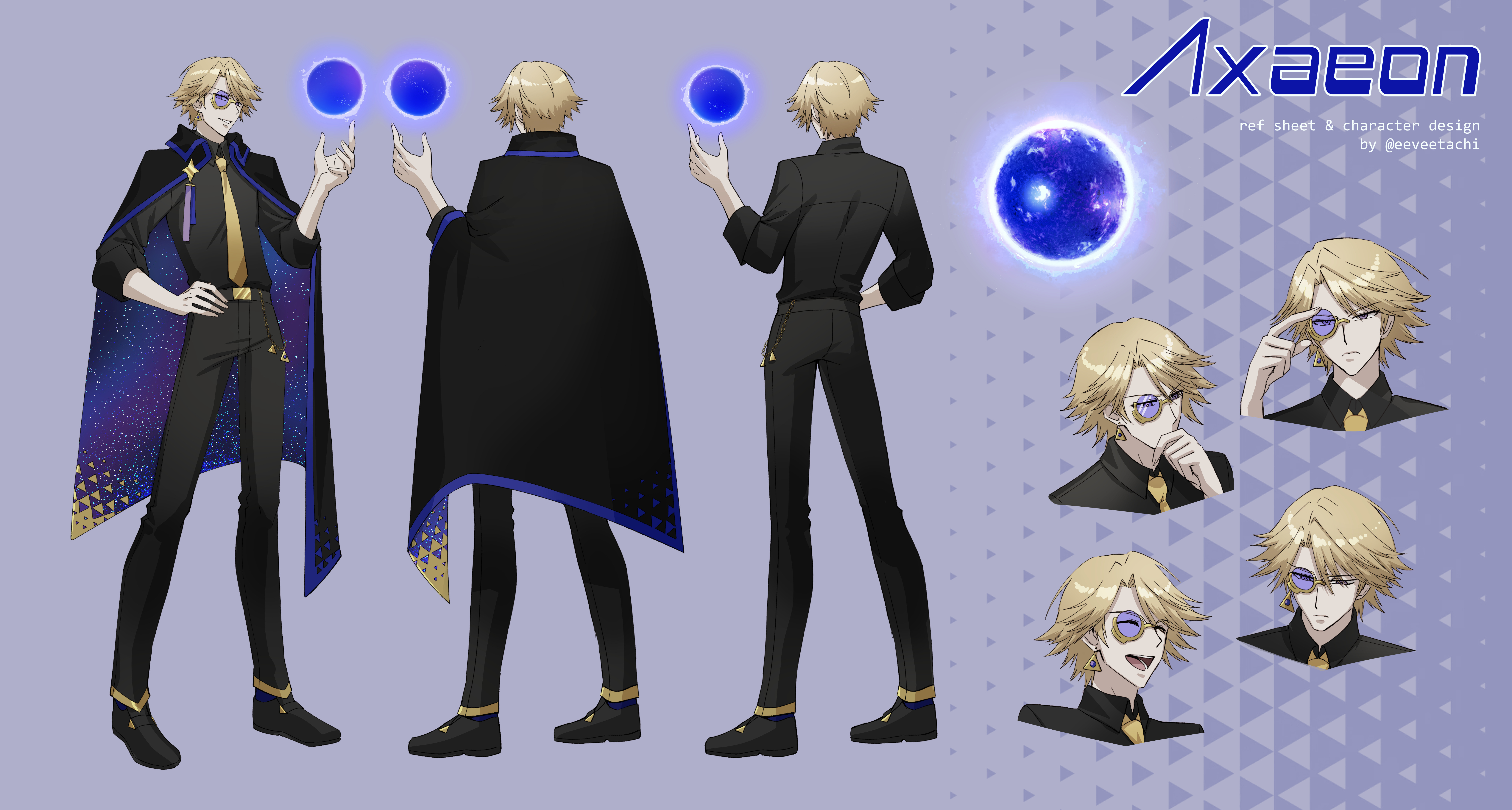
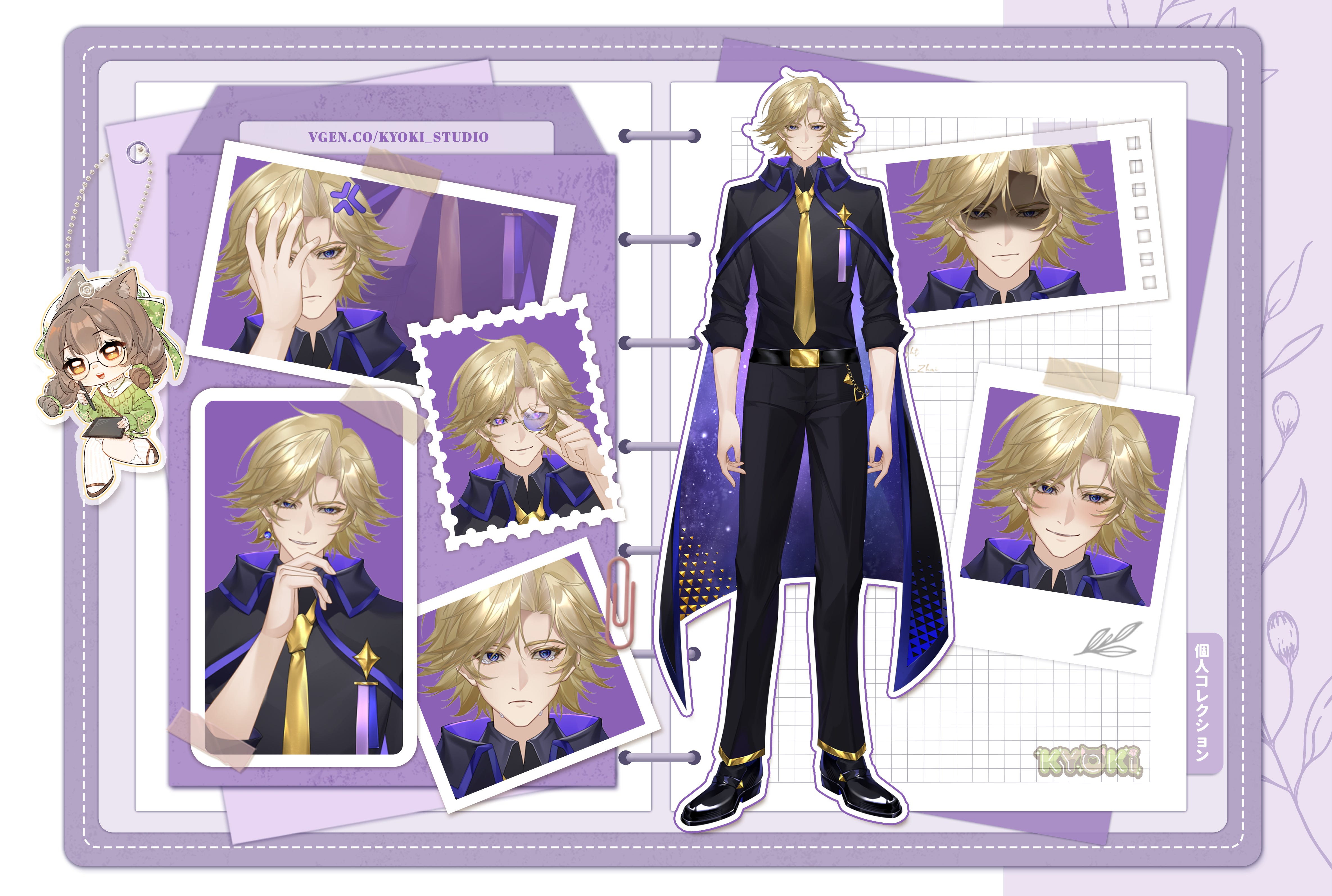
And here is his lore:
Axaeon is an extraterrestrial entity, one who has lived infinitely far into the past and whose true form is an orb of energy and light. Axaeon is first and foremost a philosopher on a quest to understand the truth about the deepest, most foundational questions that thinking entities face, such as questions about what is ultimately real, what we can know, and what matters. Having philosophized across myriad worlds in his life so far, he’s recently journeyed to Earth, where, in order to interact with and learn from humans more easily, he’s taken on a human form. In his new, human form, Axaeon likes to learn about human philosophers, discuss philosophy and writing with others, and help others think more deeply about philosophy.
One unusual thing about my VTuber channel is that I'm open about my IRL identity; in fact, I did a name and face reveal during my recent debut stream. And, speaking of my debut stream, I'd say, for anyone who'd like to get more of a sense of what Axaeon is about, that the best way to do so is to check out that stream. (See, too, the end credits sequence for the full list of wonderful artists I've collaborated with over the past 10 months or so to make both the debut stream and future streams possible.)
Here are some of the major kinds of videos and streams I anticipate doing:
Philosophy lectures and classes
Reading philosophical writings
Let's-plays of philosophical video games
Tips for academic writing
Philosophical debates and discussions2
Commentaries on philosophical readings, films, etc.
(Also, I hope, some general gaming/fun streams along the way, as not everything has to be intellectual!)
Don't worry—I plan for this Substack to continue. In fact, I'll even be integrating it with my VTubing in some ways, such as by reading some of my Substack posts on stream.
Twin Eternities (a philosophical short story)
A final thing I wanted to share here is a philosophical short story I recently wrote. The story is called "Twin Eternities," and I read it during my debut stream, as it goes into some of Axaeon's lore. I like to think that the story reading during my debut stream helps to show how VTubing can be useful both as a creative medium and as a way of exploring philosophy. As I read the story on stream, I used illustrations (for which I'm very grateful to Akeno Arata) and a soundtrack (which is probably easier to hear with headphones); while I cannot reproduce the soundtrack here, the illustrations are included below in addition to the story.
Twin Eternities
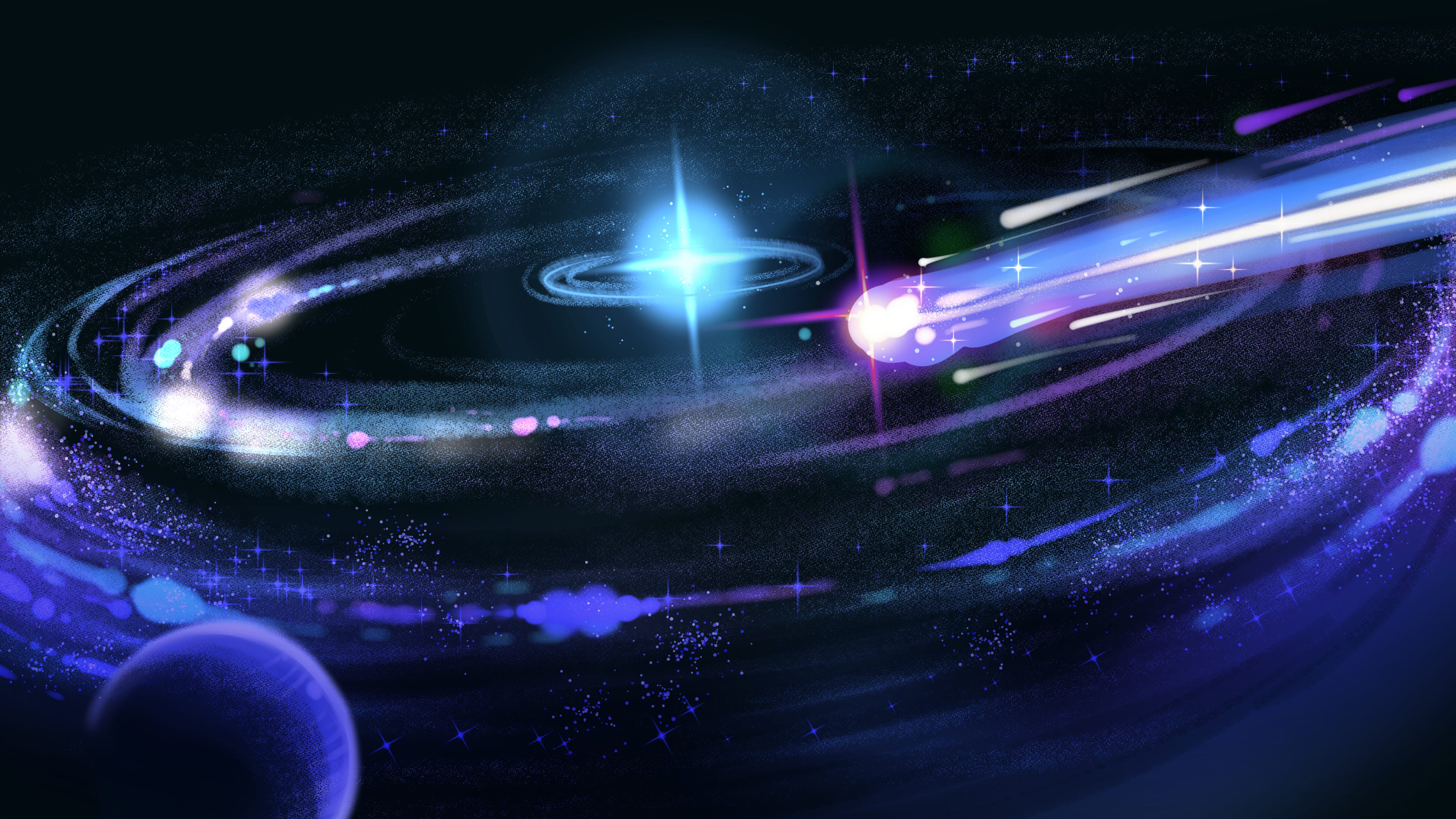
For eons have I journeyed through the night-black emptiness. Surrounded only by the stars, solemn in their silence and stillness, I fly across horizons unnumbered. No days, no nights, no rhythm of life mark my voyages—just an unbroken stream of reflection, one impelled by a desperate wish to understand. My thoughts twist and turn like flurries in windy frostlands, ever in pursuit of answers to what’s real and to what matters. For this reason I travel among worlds: to encounter and learn from others, and likewise to share my understanding with them, as far as I’m able. Most of the planets I find on my voyages are as desolate and lifeless as the void surrounding them. But sometimes I encounter other sapient beings, and we share thoughts and wishes, stories and dreams, before I must head off again. In the stretches between such times, I am companionless, save for knowing that I might be a brief blaze in the sight of some distant observer of the skies.
Once when I was reflecting on my voyages and my solitude, I came upon a barren-looking planet, its surface a mélange of faded desert and forsaken stone. It was a planet like all too many I had seen before. Yet, as I gazed upon it further, I couldn’t help but notice, just faintly visible from where I was, what seemed to be an isolated area of forest left. Intrigued, I set out for that place.
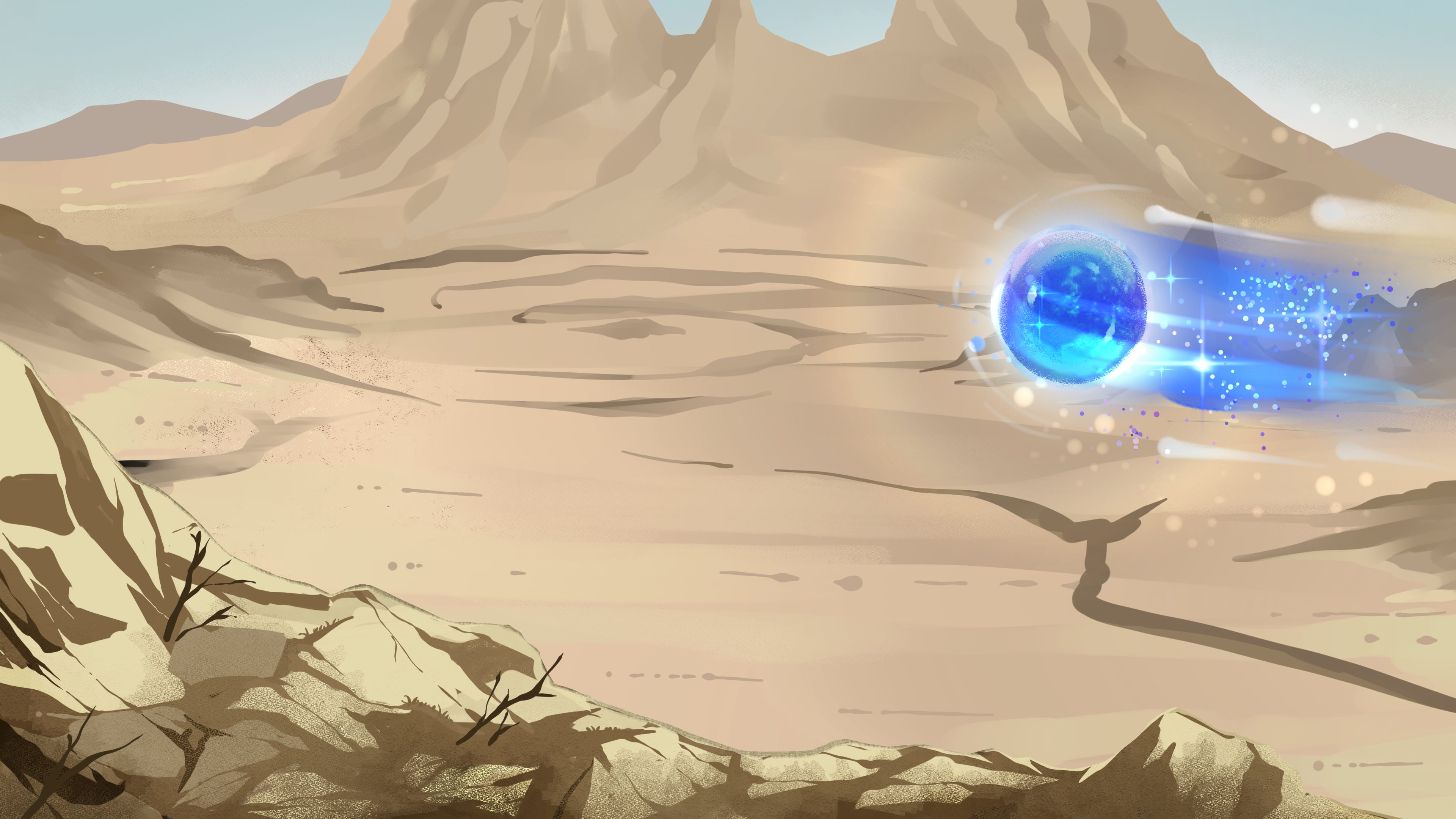
As I descended through the atmosphere, for a moment I sensed myself passing through a mysterious, azure mist, and suddenly it was as if another entity were present, but not physically—instead, present somehow within my thoughts. Before I could inquire what it was, however, the sensation dissipated, and I turned my attention to the planet’s surface as it came into fuller view. Though surrounded by an ocean of wastelands, the forest I had identified earlier was indeed there—yet even it was in a losing struggle to keep out the encroaching barrenness. The trees had long been desiccated, the underbrush almost entirely gray. Life had abandoned this place—or so I thought.
No spot within the forest much stood out, except for a cliff overlooking an empty valley. It was at this spot that I chose to land. While I wished I could have seen it in the earlier days of this planet, when the valley and cliffside were full of natural splendor, the view still held, in its own way, a dark majesty. And it was then, as I was taking in the view, that I noticed that I wasn’t the only one doing so. Lying on the ground nearby was a bird-like creature with feathers of pale green—a feature that gave him a faded look, much like the landscape around him. It seemed that the creature didn’t notice me, or perhaps was simply too weary of his world to be stirred from his gaze into the distance.
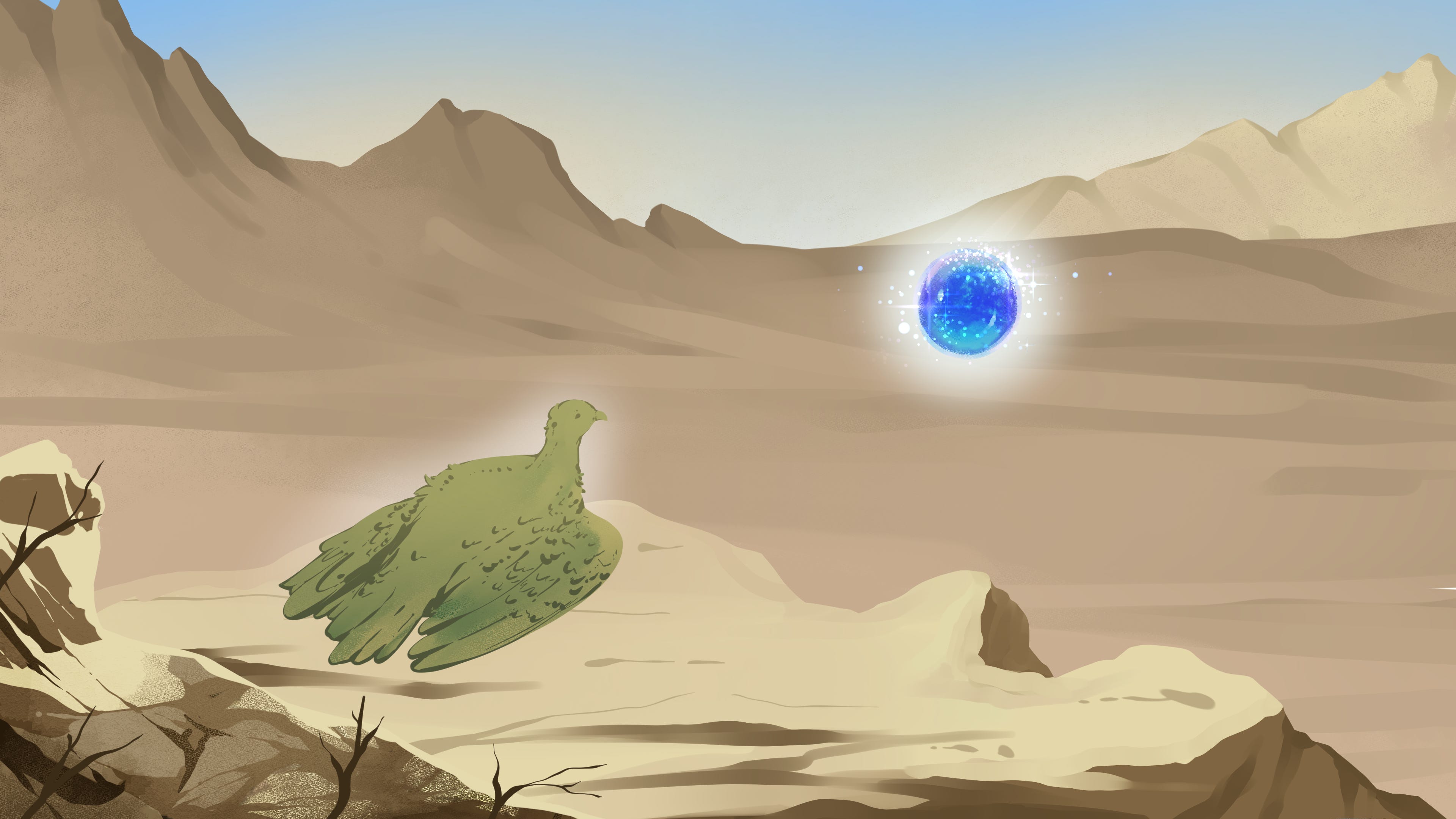
I approached, and he slowly turned his head to look at me.
“How strange,” he said, “that now, in my final days, I should at last have a visitor.”
In his words weighed heavily the sense of a hard-fought wisdom, one dragged through secluded ages of imagining and longing for things far away. In this vein, what most struck me was not that I, having never heard his language before that moment, could yet somehow understand him (and sensed that he’d understand me, too); rather, it was how he wasn’t taken aback by my form, even though it was probably his first time encountering a being who looked like me, an orb of energy and light. Instead, he had simply acknowledged me as a visitor. I was immediately curious to hear more about this creature—his background, what happened to his planet, whether there were others like him. However, rather than pressing him to say more, I felt it more respectful to first introduce myself.
“Yes,” I replied, “I’ve come to visit your planet. My name is Axaeon.” I then described my background—how I had traveled across vast reaches of space, stopping at myriad planets along the way, in pursuit of wisdom. How I had taught and learned, shared friendship and memories, with the beings I encountered. How this same journey had brought me at last to this planet. After describing all this, I paused for a bit, then said, “I’d like to hear more about you. Could you tell me about yourself and this place?”
He looked into the distance for a moment before responding. “I am Nyra’keth—or, at least, that is what they used to call me. I am the last of my species.”
Another pause. “Many centuries ago, there were more of us. We flew in great numbers across the skies, radiant in the rays of our sun. Yet the more perceptive among us could see that our planet was slowly dying. As the flora faded, barren expanses took over, food became scarcer, and other species died out one by one. In time, only this one forest was left—and it, too, was in the grip of decay.
“As the life drained from our planet, we tried to stop it in our own various, paltry ways. Some of the elders did desperate dances to now-forgotten gods. Others tried to store and ration scraps of food as best as they could. And then still others entreated the Presence.”
Sensing my confusion, he continued, “The Presence—perhaps you felt it upon arriving at this planet. It’s an entity of mysterious powers. When it is at its nearest, it manifests as a blue mist, and it can summoned simply by willing so in one’s mind. It does not speak, but communicates by way of thought transference and visions. It is no doubt by its mediation that we can understand each other, despite our lacking a shared language; for a reason known only to it, it wishes for us to be able to communicate. In a similar way, the Presence has long been a facilitator or companion, of sorts, to my species—a being who has ever watched over this planet, and whose support and guidance one could seek at any time, even though its communications are sometimes cryptic.”
His face grew darker. “Yet, alas, its powers are limited. No matter how hard my people begged the Presence to save us and our planet, it expressed to us, in its own way, that doing so was beyond its abilities. And, as much as we didn’t want to acknowledge it, we all knew it must have been true—for the Presence had never, to anyone’s memory, imparted to us a falsehood.
“It was around that point that we, the last remaining members of my species, resolved not to have any more children, as their lives would have known only hunger, desperation, and loss. I was still quite young myself then, too young to have children of my own, but I remember the day the rest of my people made that decision—the day we came to terms with the truth that our race was at its end.
“As our numbers dwindled to a mere handful, the ones who remained lacked even the strength to bury those who had fallen. Finally, somehow, it was just me and one other left. I held her in my wings as her life faded; I wanted to comfort her, but I could find no words. Then, when she had breathed her last, I was the only one left—surely soon to follow the others, I thought.
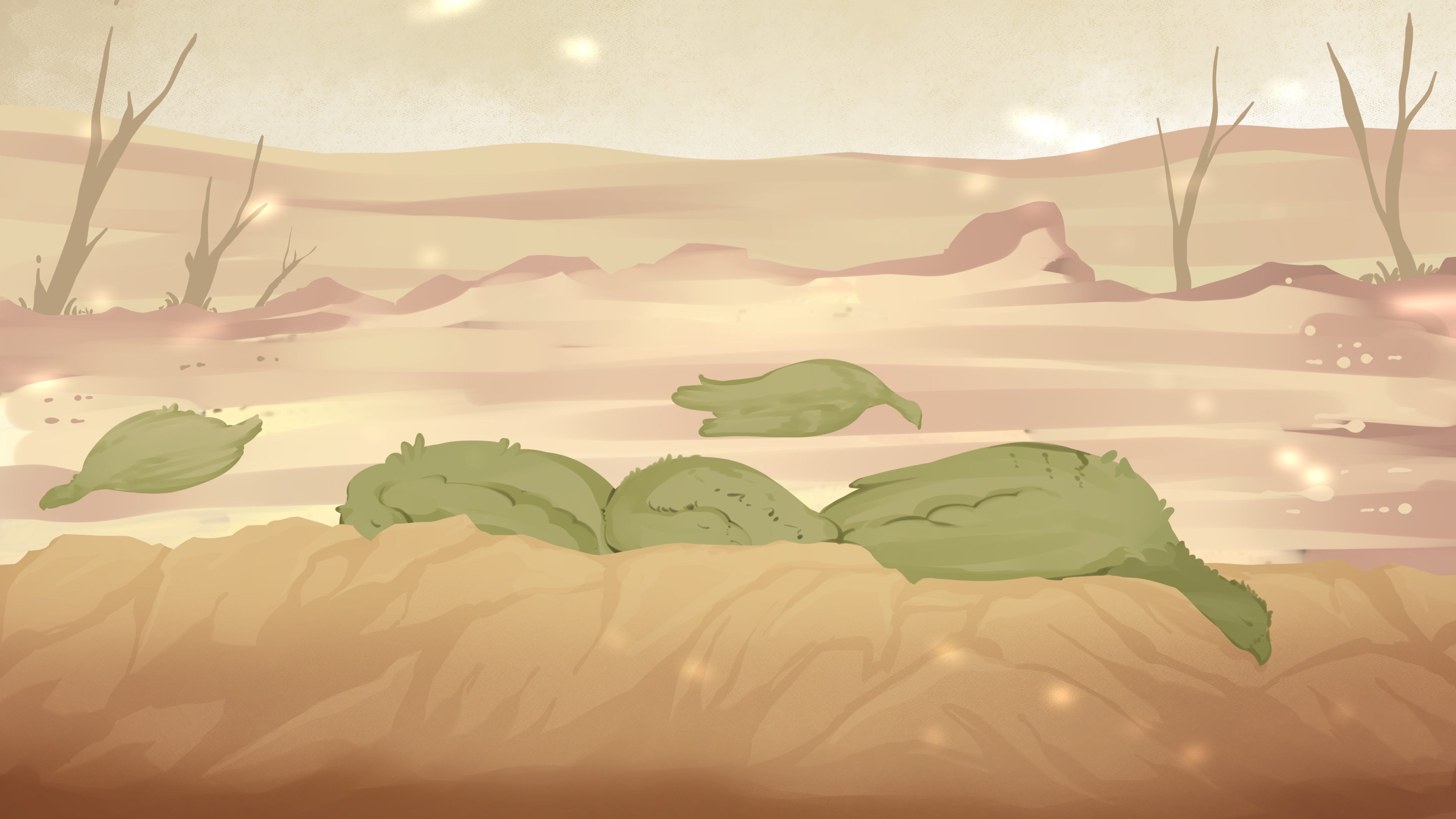
“But suddenly, the Presence appeared to me. Into my mind it sent dreamlike images of me continuing to live, continuing to fly, carrying on the memory of my species. Somehow the Presence likewise imparted to me an unspoken understanding that it didn’t want my species to end, and that, while it was powerless to save all the others, it could still save one—namely me, the last one. It let me know, further, that if I were ever to wish to die, I could fulfill such a wish simply by having it; by acknowledging to myself that I no longer desired to live, I could bring myself face to face with a natural death once more. However, as long as I maintained the will to live, I’d go on living. All I had to do to bring about such a future was let the Presence infuse me with the strange power it offered: the power to leave death enchained, and myself the one holding the key.
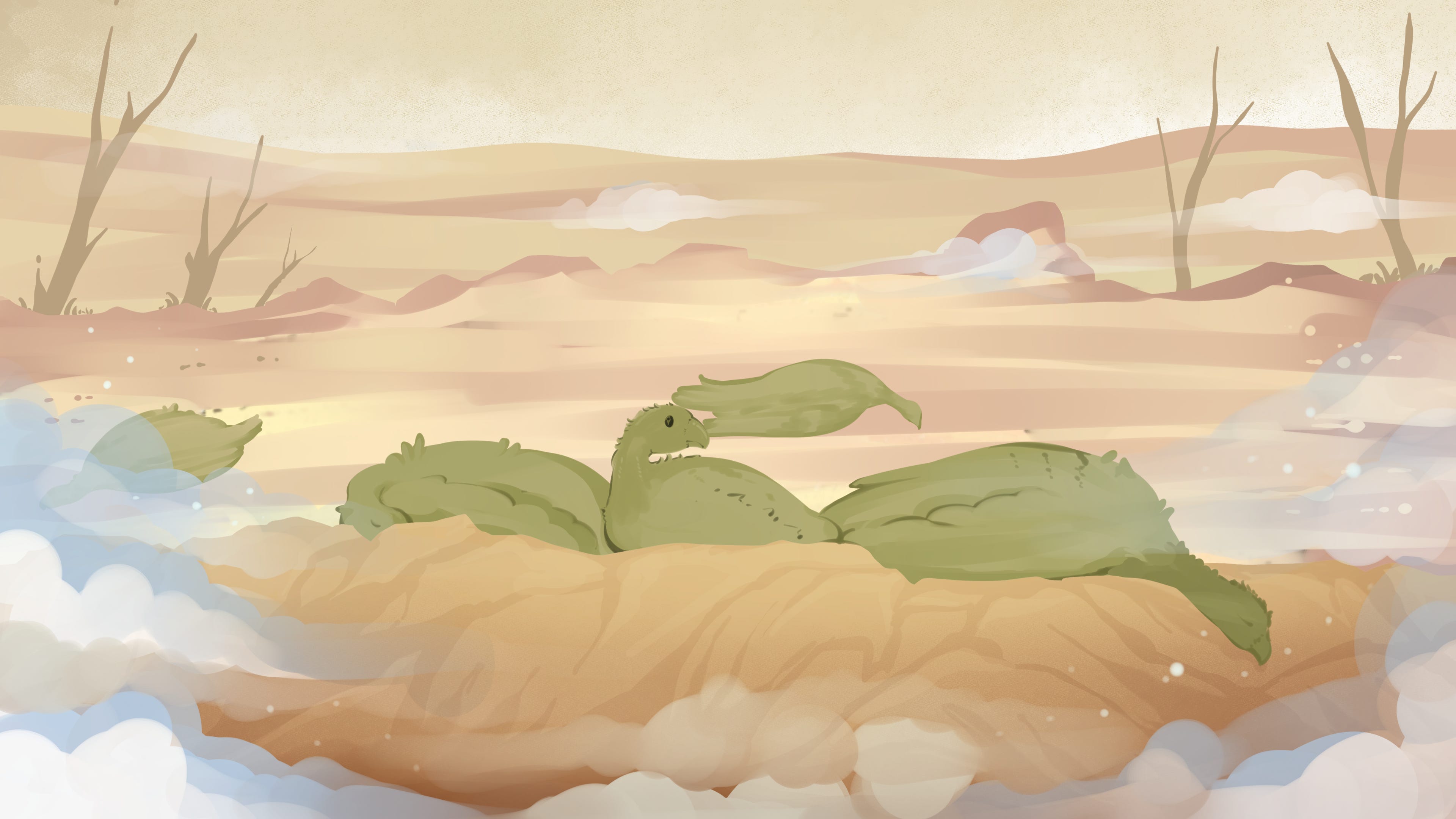
“In my weakened state, teetering on the brink of death already, the Presence’s offer was salvation. No longer even able to speak, I could barely muster to think the word ‘yes’—but that was all it took for the Presence to begin its work. In an instant, I felt restored, healthy, whole again. My body had transcended hunger and thirst; no longer would any physical need ail me. As I spread my wings and took to the sky once more, I felt overjoyed—for, in truth, death had always frightened me. In my happiness at my renewed life, I began journeying to far-off lands, lands I had never seen before but had always wished to explore. I came to know this world in a new and deeper way, deeper than had ever been available to anyone of my species.
“And yet, as weeks turned into months, months into years, years into decades, loneliness crept in ever more deeply. Everywhere I flew, there was only silence. I had no one to speak with, no one to share meals with, no one to hold or be held by, love or be loved by. It was an existence of unrelenting solitude. True, there was still the Presence, but it was ever too distant, mysterious, and aloof to be a relatable companion; no possibility was there of holding a conversation with it, sharing laughter or tears, or developing any true bond, not in the way one might with a being of flesh and blood. I—”
His words caught in his throat for a bit as he glanced back at me. “A poor choice of words—I meant no offense.”
“You need not worry,” I replied. “I’m not one to take offense.”
Another pause as we looked out together into the distance. I couldn’t help but feel a certain kinship with Nyra’keth—for he, too, knew the burdens of journeying ever in aloneness.
“One day,” he continued, “I summoned the Presence and asked it, begged it to grant me the power to leave the planet, so that I might find others. If I could fly among the stars, and someday descend upon a new world, perhaps I could find a real home, be part of a new family, and pass the days together with them and with all others who’d welcome me. Oh, how I yearned for this! Alas, the Presence was unable to grant me such a power; I was to be just as bound to this planet as it was. In time, the planet came to feel like a cage—a vast one, but a cage nevertheless.
“Since then, I’ve flown and reflown every path, counted every crevice in every canyon, become as much a feature of the landscape as the fallen carcasses of once-great trees. As the planet ran out of new spaces for me to explore, I turned more and more to imaginary worlds, creating vast stories in my head and telling them to equally imaginary audiences. My stories of love and hardship, adventure and tragedy—through these I entertained myself and kept my capacity to feel. Often I would, through imagining my stories so vividly, bring myself to tears. But as much pride as I took in some of them, even the stories eventually seemed to dwindle and run out. The only thing that lasted forever was the silence that always greeted them.
“Thus it was that, just a few days ago, I decided that there was nothing left for me. After requesting the forgiveness of my fallen family and companions, I summoned the Presence and thought to it that I no longer wished to carry on. In that moment, I suddenly felt them again, the sensations I had long forgotten—sensations of hunger, of thirst, of aging. The power had played out just as the Presence told it would.
“For all that, I knew that I could reverse my decision if I wished, and, upon entreating the Presence once more, again become ageless and free from hunger and thirst. And, though I’m ashamed to say it, the sudden harshness of the pain I was newly experiencing tempted me for a moment to choose that path. Yet I remained committed to the end I had set for myself. I knew that I was nearing my final moments, so I came here, to my favorite place, this forest cliffside that I had known from my youth, to die peacefully. And that’s when you arrived.”
As Nyra’keth finished his recounting, I felt overcome with the cosmic injustice of his circumstance. A being of such apparent humaneness, one who had endured lonely centuries of longing and grown so greatly in wisdom, at last having to resign himself to ending this way, trapped on this wasteland of a planet—yet what could I do to help him? As he had just told me, the Presence had been unable to grant him the power to venture through space, a power that I had always had. Yet there was a part of me that refused to accept it; if only Nyra’keth could share this one ability, it was clear to me that he’d immediately reverse his decision to die, and would once again become immortal (for as long as he wished, anyway), and the tragedy would be averted. A life of newfound fulfillment would await him.
In a desperate plea, I summoned the Presence through my own thought. I then, likewise in the silence of thought, addressed it thusly: “Mysterious Presence, long ago, you helped Nyra’keth by giving him the choice to continue living. Might you help him again by granting him the power to ascend among the stars and venture to new worlds, so that he can live a life beyond that which has grown so stale and gray to him in the centuries he’s been confined in his aloneness on this world? So that he might have reason to reverse his decision to die, becoming ageless once more? I will, if he wishes, be the first of his new companions and guide him on his journey through the faraway reaches of space. While I know you were unable to grant him such a power before, does that truly remain the case? Has there been no change in your abilities in the centuries since then, no change that might now make it possible after all to grant Nyra’keth the power he’s so longed for?”
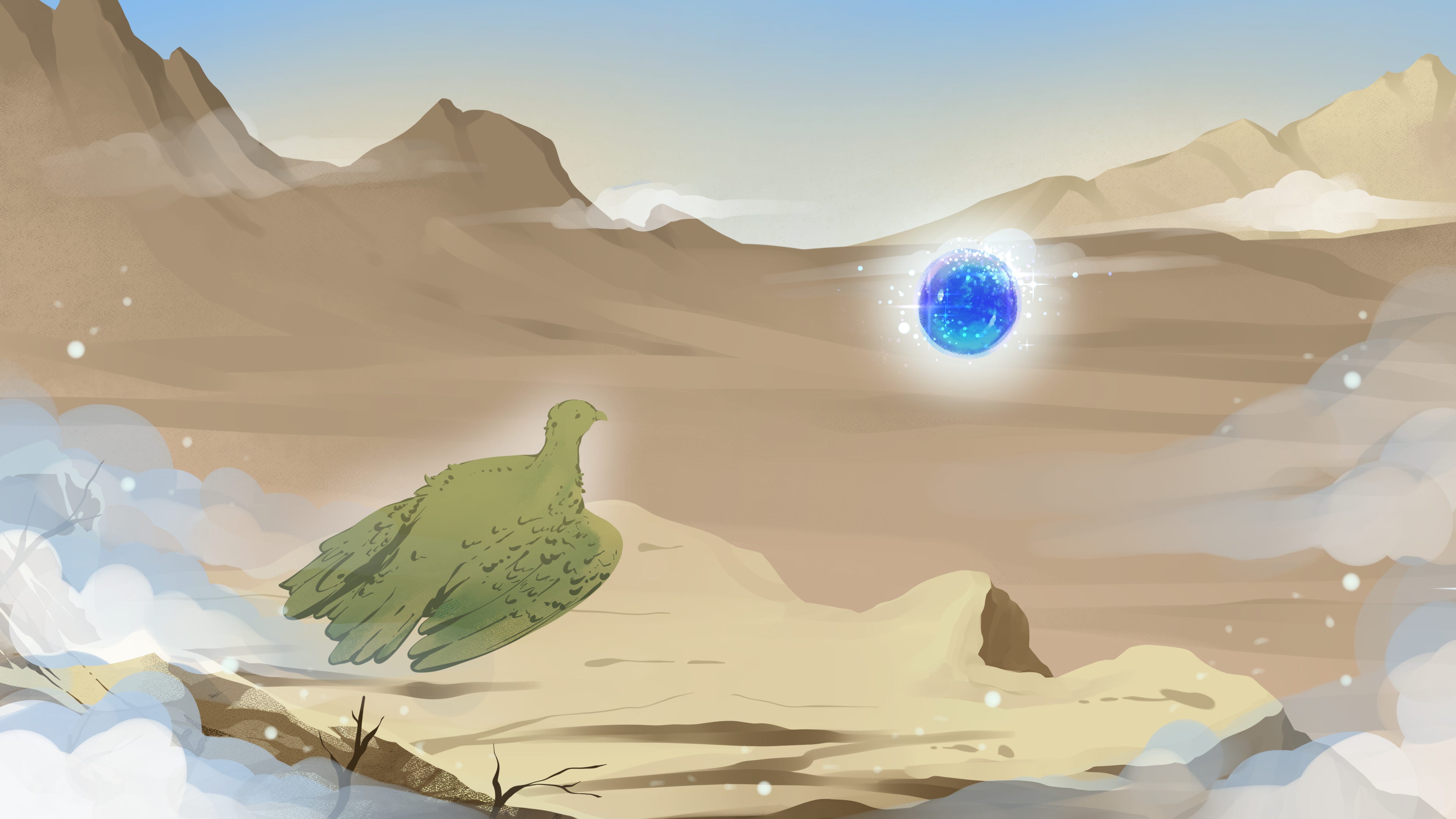
For a moment, there was silence. But then, in a flash, images flooded into my mind (and, I somehow knew, into Nyra’keth’s as well)—images of the two of us traveling through space together, visiting faraway worlds, finding ourselves among newfound friends. Of Nyra’keth no longer drear and faded, but beaming with an unsurpassable fullness of joy.
At the same time, a thought was transferred to our minds, the closest thing to a voice from the Presence: “Be it known that I now can grant the dying one the power it’s wished for—this thanks to your being here, orb. You have the power of traveling through the space beyond this world; by drawing from your power, I can, with no harm to you, grant to the dying one the ability to so travel as well. Further, I can, in the same act, restore his immortality. But beware: Should I so grant him the power to venture to distant worlds, his restored immortality will be irreversible. No matter how greatly he may one day long for death, death will ever be beyond his grasp; he shall be bound to continue living. I cannot render it otherwise.”
Were any other being to have delivered such a thought, I might have been inclined to argue or at least request an explanation of why the immortality could not be reversed. However, the Presence’s thought carried with it an air of such authority and truth that I knew there’d be no point in arguing; what it told us about the choice facing Nyra’keth was as certain as anything could be.
I sensed that Nyra’keth had understood the Presence’s message as well. In that moment, we both felt the force of the dilemma he faced: whether to accept imminent death on a forsaken planet, or to at last be granted the power to travel to new worlds and find new fulfillments—but with the provision that the accompanying immortality could never be taken back.
After what I felt to be a suitable pause, I asked Nyra’keth what he wished to do.
“The power to venture to worlds beyond is one it pains me even to contemplate turning down. It is what I have wished for more deeply than I ever believed I could wish for anything.” He had been looking into the distance as he said this. But then he turned his gaze downward. “Yet knowing that the immortality would be irreversible—that alone forces me not to accept the offer. I must instead choose death.”
I remained still, thinking over his words. I couldn’t help feeling that the choice was tragic—not just the dilemma facing him, but the choice he himself intended to make. As much as I wished I could simply support his choice in a spirit of understanding deference, I felt, if I was to be honest with myself, that he was making the wrong choice. The other way, the way of eternal and unbreakable life, I felt to be the better path.
“Would you be open to talking about your choice?” I asked.
“With one as thoughtful as you, yes,” he replied. “It’s a decision of great moment for me, after all—one far too great for me to claim any certainty that I’m making the right choice. I welcome your perspective.”
“And I’m happy to share it. But first, tell me, why do you wish to choose death over irreversible immortality?”
“Were I to make the other choice, and bind myself to life eternal, all would one day become intolerably boring and bland. Even though living among the stars and exploring vast new worlds would stave off the boredom for a time—for millennia or eons, even—eventually I’d have experienced all that there is to be experienced, and life would begin to feel much as it’s come to feel being on this planet, trapped in interminable sameness, interminable cycling and recycling of experiences staled almost beyond recognition. And, crucially, I’d have no escape; I’d be forced to continue living evermore, no matter how achingly I might one day wish to be released from it all. Better to simply end things now than subject myself to such a fate. However, I’d be curious to hear your view.”
“You state your case well,” I said, “yet I believe that you’re making a mistake. Choosing immortality, even an immortality that one will be forever unable to sever, seems to me the right path. You’ve expressed a worry about being powerless against encroaching boredom, but I believe that boredom is more easily driven back than you’ve suggested. Some experiences never lose their specialness—experiences like spending time with those you love, or taking in the beauty of high art, or even simply resting when one grows fatigued. Provided that there’s enough variety between such experiences—that is, that you’re not simply doing the same thing over and over again, but instead maintaining a fitting mix of activities and endeavors—life’s fulfillment will persist without end. My own experience attests to this—my having lived for countless eons and, for all that, not only finding life no less worthwhile, but, if anything, valuing it ever more fully, more deeply, through all the years and distance. I’ve found that there are always new experiences to have, and even if there weren’t, the kinds of experiences I have had would be more than enough to remain worthwhile to go on having for the rest of eternity. I believe that if you were to choose to live out there, voyaging among the stars, you’d come to understand that such a life can carry within it a beauty beyond dreams, and that no amount of time, however extraordinary, could ever induce it to fade.”
He looked at me with a soft sadness in his eyes. “I wish I could believe it were that simple,” he said. “But your words make me think back to when, as just a hatchling, still too young and weak to fly, I looked with longing at my older and more gifted nestmates as they took to the skies. I thought that if I could just fly as they did, and venture out into the fullness of the world, I would never want anything else, would never again know boredom or melancholy or lack. Oh, how naive I was! The exuberance I felt in my first flights belied the eventual emptiness, the joyless silence and monotony, that flying was bound to have for me in the centuries to come. I can only sense that it would turn out the same if I continued living—even out there, with this new kind of flight I’ve been offered, flight among the stars. Perhaps our natures are different in this regard; you have the capacity to keep strong within you that fullness of engagement and appreciation, even for things you’ve seen and done countless times before. Truly, it’d be better if I were like you in this way. But I am myself, and the extent of my self-knowledge, built up over these many centuries, is telling me that the experience of eternity would, most regrettably, not be the same for me as it has been for you.”
I persisted: “You’re neglecting to consider something important, namely that past a certain level of experience, you’d gradually forget much or most of what came before—much as I have. As the eternal march of time went on, you’d find yourself coming back to things you’ve done before, even things you’ve done many millions of times, and finding the experience new and refreshing—provided just that enough time has passed for you to have forgotten, more or less, the previous time doing it. Forgetting can lend to one’s experiences within eternity an ever-renewing sense of discovery.”
“If that be so,” he replied, “then I’m afraid it can only lead me to reject eternal life in a yet deeper way. Were I to eventually forget most of what I’ve experienced so far—growing up among my family and friends, facing the deaths of the others of my species, enduring the lonely centuries after, exploring the planet, creating all the wondrous stories in my head that have become so dear to me—then whoever’s left at the end of such forgetting would no longer be me. So much of what I now think and care about would be lost from that being’s psyche that, as I try to envision what such a being would be like, it feels less like imagining a future version of myself than simply imagining some distant stranger, a stranger about whose future existence I can no more bring myself to care than about any random being’s future existence. If I’m to cease being the Nyra’keth I am now, I wish to do so by the quick and honest hand of death, rather than by letting myself be chipped away piece by imperceptible piece over the unsparing march of eons.”
“Your point,” I acknowledged, “brings up an important question, namely under what conditions you yourself persist. It’s a question that philosophers across many worlds have confronted. It seems that your view is that if enough of your memories faded, and even if their fading and replacement with new memories were gradual rather than sudden, you’d become a different entity—not simply a future version of yourself with different qualities, but someone who is no longer you at all. We have a difference of opinion here; I believe that you would still exist, just with different qualities from those you now have. However, that’s of course a many-faceted debate, and—forgive me—one I’m not sure we have time for. Do we?”
“No,” he said. “Alas, my time grows short.”
“Then let us to turn to something briefer. I feel, as I do for any sapient being, that there are things in this universe that only you can do, gifts only you can contribute. If you choose to venture to new worlds, you’ll be able to share your gifts with others; no longer will you have to keep them isolated within yourself on this life-abandoned planet. But by letting go of your life now, you’ll never go on to let those gifts see light; no one will be captivated by your stories, edified by your wisdom, or heartened by your strength. True, those who miss out on your gifts will never realize it, yet I don’t find that that makes it any less tragic a prospect; if anything, to me it makes such a future seem even sadder. You might not feel that you need eternity. But what if eternity needs you?”
“Yes,” he said, “it is, in a way, selfish of me. And yet, however great the stakes might be for others in whether I continue to exist (if I don’t thereby flatter myself), somehow the stakes for me feel yet greater, such that perhaps a little selfishness can be forgiven me. What drives the stakes up for me, in particular, is the possibility that my life will become in some way intolerable. I know we’ve discussed boredom already, but here I have in mind things yet worse: ways an inextinguishable life might become an inextinguishable nightmare. What if, for instance, I someday encounter a being or beings who lock me into a confined space, where I remain helpless ever to escape, and where even death cannot one day save me? What if I’m bound and tortured by similarly malevolent beings, ones who delight in my having not even the hope of death as a reprieve? What hells does an eternal existence not make possible?”
“As you began in your journey beyond this world,” I responded, “I could protect you. And over time, as you explored new worlds and civilizations, you’d develop more knowledge and capabilities, becoming ever more self-reliant and able to defend yourself. With such development, it’d become less and less likely that you’d go on to become trapped in a nightmare scenario like the ones you’re imagining.”
“But you cannot guarantee that such a scenario would never happen. It might be beyond our power to prevent, or it might come for me after we’d have parted ways (assuming we one day did), such that you wouldn’t be able to protect me from it.”
“You’re right,” I replied, “that I cannot guarantee that such a turn of events will never come to pass. However, the steps we can take to make it less likely are, in my view, enough to make eternal life an option worth choosing, if it weren’t already otherwise so.”
“Perhaps—I acknowledge that it’s difficult to know,” he said. “But in this moment, what most strikes me is how greatly you seem to care about my life. One as ageless as you has surely seen countless deaths. Does it not all numb you toward death after a time? How is it that you can bring yourself to so genuinely care?” For the first time in our conversation, his voice carried ripples of emotion.
“It’s true that I’ve seen death claim countless beings in my time, yet that’s never made it seem to me any less a tragedy. All the lives I’ve witnessed be cut short, willingly or unwillingly, have only deepened my sense of the weight of it, of how the universe itself seems to suffer every such loss. Even distant planets, where no one knows a given being who died, or where no one has ever lived at all—even such places as these now seem to me marked in their own inscrutable way by faraway tragedies of death. Every life’s ending carries a silent shockwave through the universe, one that faintly darkens all it touches, even if our eyes are not attuned to see it. Not many are given the chance to live forever—please, don’t let this opportunity go untaken.”
At this, he looked at me again, and I could see that his eyes seemed yet more faded than before. “You are a good being, Axaeon. I thank you for sharing your thoughts with me; they truly have been a testament to your compassion and sincerity. Your reasons have moved me—but, alas, only by furthering my regret at what I must do. I’m afraid that, in the end, death remains the choice to which I must resolve myself.”
We remained still for a time. I wondered whether I should tell him that I understood his choice—though, in truth, I wasn’t sure I did understand it. However, before I could say anything, the Presence reappeared, and it addressed a thought to me—one that, translated into words, was something like this: “You spoke truly before: The dying one is making a mistake. But it’s not too late; let me draw from your powers, and, his will aside, I can grant him the immortality he’s rejected—and, with it, his hope of a future of value. We must act quickly, though; let me draw from your powers now so that I can save him before death claims him forever!” Then, with equal suddenness, into my mind flooded images of Nyra’keth and me in the future—flying together among the stars, visiting faraway worlds, conversing, laughing, regaling others with tales of our adventures. But were these visions of what would eventually happen if immortality were now irreversibly foisted on him? Or merely what might go on to happen? And even if, someday, he would feel grateful for such a turn of events, despite however distraught and betrayed he would feel now—how much should that matter to me, in this moment, as I wrestle with what to do?
The images the Presence showed me, images of profound peace and fulfillment within the still-possible future of Nyra’keth’s travels, continued to swirl about my mind. And it wasn’t simply that I was seeing all these moments; beyond this, I could feel the feelings bound up with them, the weight of all the memories we might go on to have. In this one flash of visions, it had come to feel as if Nyra’keth was not someone I had just barely begun to know, but a close friend of 100 years. All this made me feel all the more deeply the fullness of Nyra’keth’s being, the goodness he could contribute, the tragedy that would faintly linger ever after if he were to die. And yet, no less present in my mind was the sense that even though Nyra’keth, in my judgment, was making a mistake, it was his to make. To interfere in so personal a matter, to run roughshod over his right to decide his life’s course (up to, and including, its end)—I could not bring myself to do it. I turned away, and the Presence, sensing my choice, left us alone once more.
Then, still looking out into the distance, Nyra’keth said, “I could sense it, just now—the way the Presence attempted to convince you to help it force immortality upon me. The way you resisted, the way you respected my choice even while disagreeing with it. Thank you.”
“If I’m to be honest, I cannot help but feel that I might one day regret it.”
“All the same, I am grateful.”
Nyra’keth then turned to me and said, weakly, “Even though our opinions differed on what was to be done, it was clear to me, from nearly the moment we began speaking, that you care—about others, and about me. As strange as it might sound, talking through this choice with you was like having a friend—the first friend I’ve had in centuries. I can scarcely have wished for a greater way to spend my final moments.”
He turned slowly back to gaze out beyond the cliffside, into the sky, then closed his eyes. Gradually his breathing slowed, until at last he breathed no more.
In the silence that followed, all I could think to do was begin gathering stones. As I placed them around Nyra’keth, I didn’t know whether this was the manner of the burials he would have been familiar with—we hadn’t had the chance to talk about that—but it was the most dignified way I could think to leave him there.
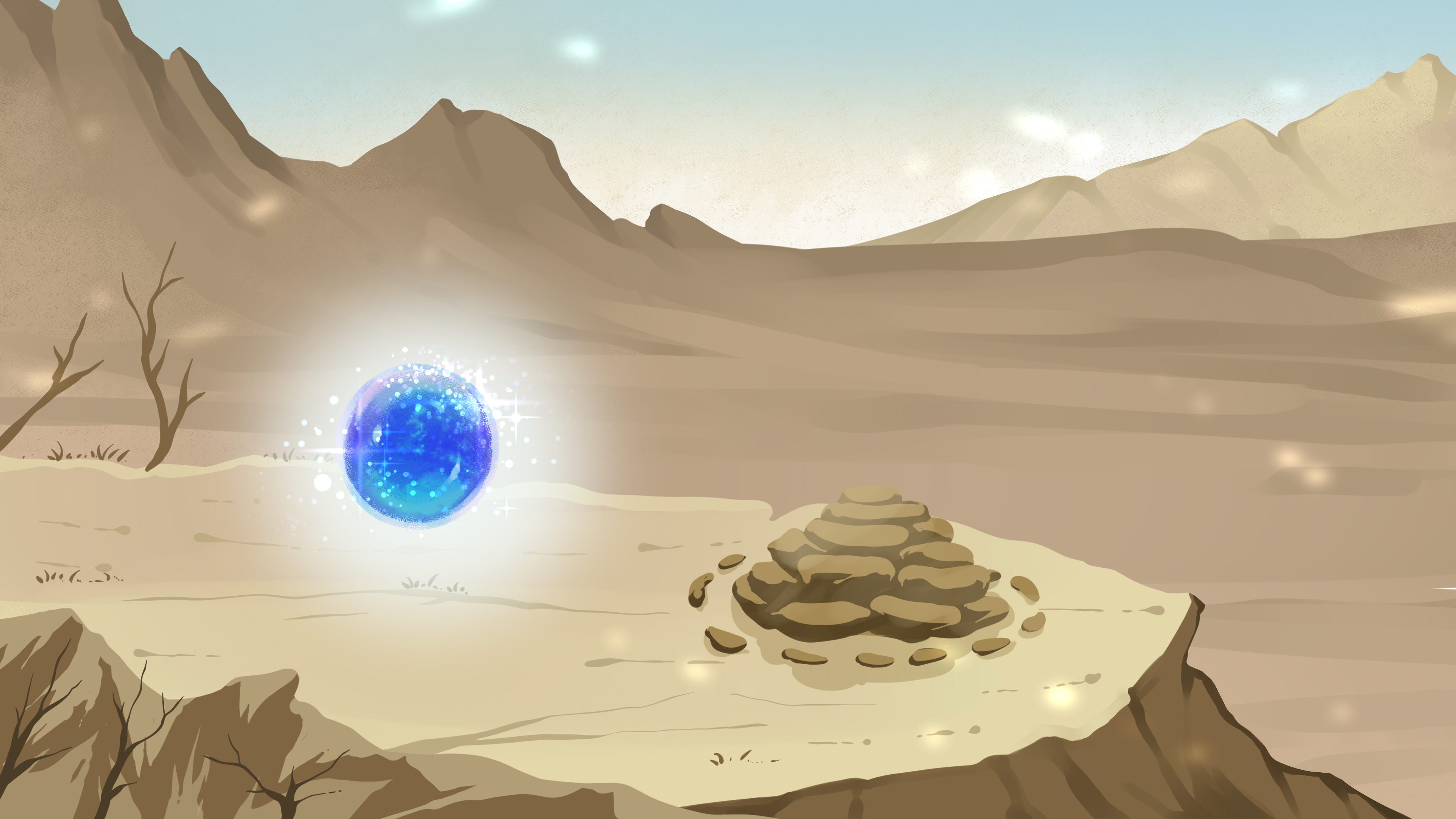
There was then nothing further for me to do on that planet—except one thing. I summoned the Presence once more, and, in my thought, I addressed to it the question of what it would do, now that it would be truly alone on its world. It gently placed into my mind a thought that I can best translate as follows: “I remain bound to this planet. But worry not for me; I do not experience loneliness in the way most other beings do. I shall wait here for the next traveler; perhaps when one arrives, I’ll be able to help in some way, much as I tried to help your brief companion. In the meantime, farewell on your voyages.”
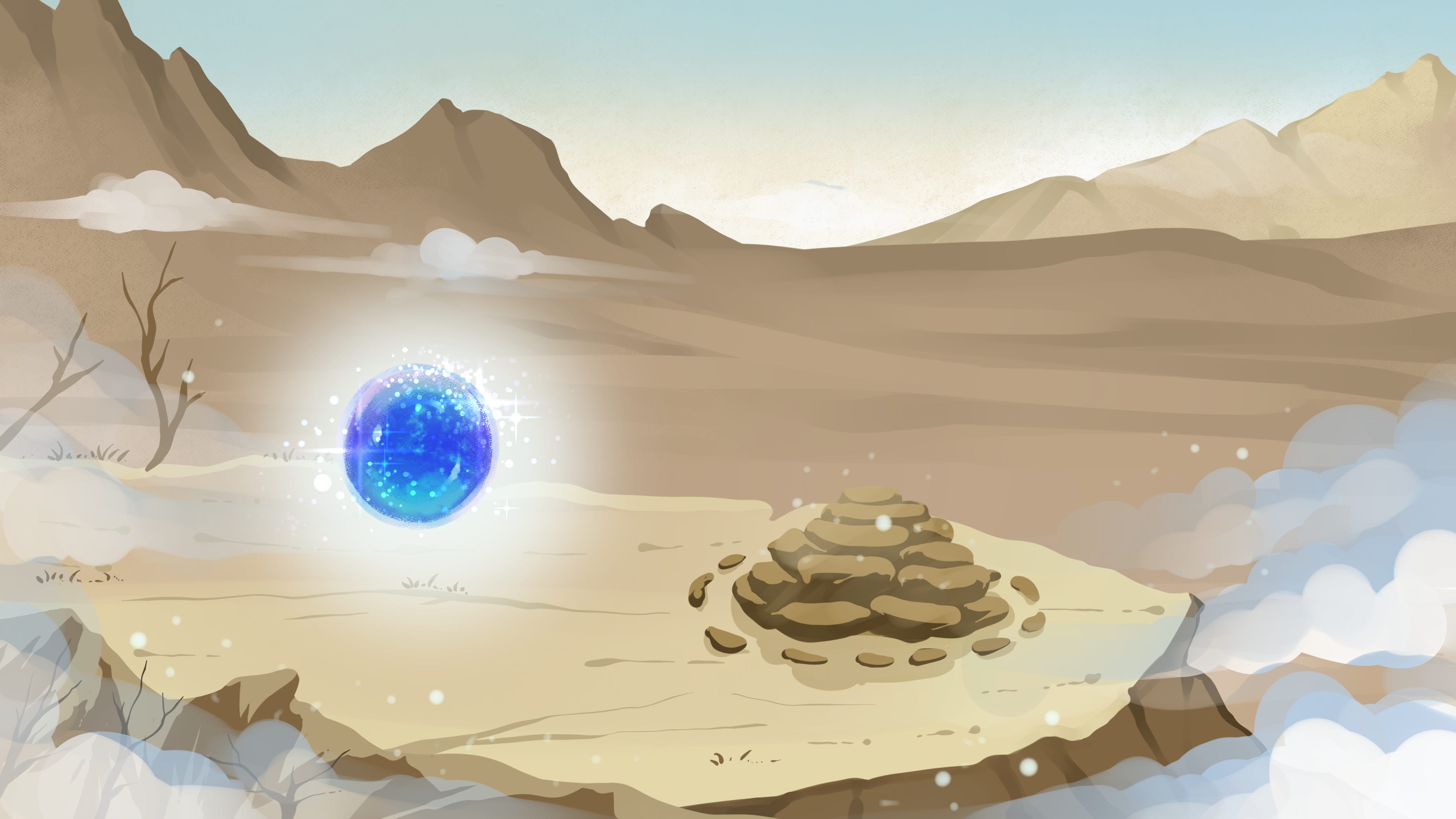
Then, after returning the farewell, I ascended into the atmosphere, gaining more and more speed as I launched myself away from Nyra’keth and his planet, away from the Presence, away from the brief moments we had shared. I suddenly found myself with the thought that I could—no, that I would, that I must—keep Nyra’keth alive in my memory, and that, by going on to tell others about his life, perhaps I’d be preserving something of a legacy for him. It was a thought that promised to offer a tender sliver of consolation—yet I couldn’t help sensing, in its wake, how different being kept alive in others’ memory is from being alive in fact. Nyra’keth had been a being with his own consciousness, his own embodied subjectivity, one complete with hopes and fears, with love and sadness, with stories and wisdom and heart. The living essence behind all this was lost forever, and my memory of Nyra’keth, however special to me it might be, could no more preserve his fullness and aliveness than could the rocks now covering his body.
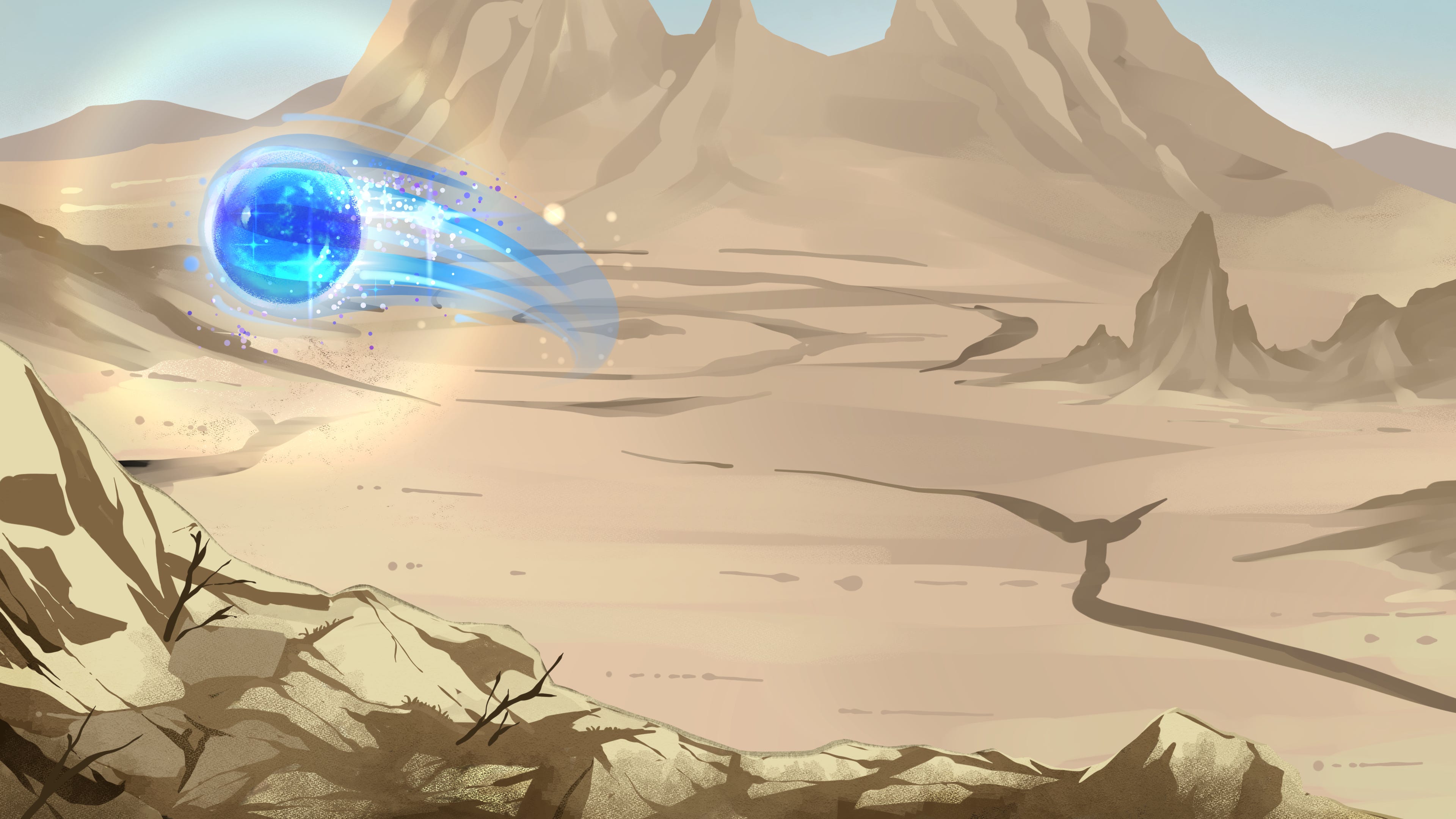
With these thoughts dwelling in my mind, I set off once more into the vastness of space, off to journey alone in search of other worlds—ever onward into the dark horizon.
I hope you've enjoyed this introduction to Axaeon and to my VTubing journey. Thank you for reading, and I greatly look forward to continuing!
The educational potential of VTubing seems to me especially untapped when it comes to the humanities. The sciences have made more progress in this regard, as there are several active science VTubers, such as Syzygy Altair (physics), Myelin Achemon (psychology and statistics), Nepenthes (horticulture and entomology), Phy The Neutrophil (biology), and Psydere (psychology)—together, the members of the STEM Vtuber group VTheorem. Lest it be thought that I'm the only VTuber in the humanities, though, I want to mention that I'm not the only one, nor even the only philosopher VTuber. The honor of being the first philosopher VTuber goes to Charis Euphranor.
On that note, if you're a philosopher reading this who'd be interested in setting up an interview, debate, or discussion sometime, let me know!
This sounds like a great idea!
I've done some YouTube videos for my classes - the most recent ones are the lectures from an online AI Literacy class I've been teaching, but the others are mostly "Let's Read" videos. In these videos, I read through a full philosophy paper, while giving a commentary on what the author seems to be trying to do in each passage, and what background they are responding to. I started doing this because it helped me assign readings to students who didn't necessarily have as much familiarity with some of the background.
https://www.youtube.com/@keaswaran0/videos